













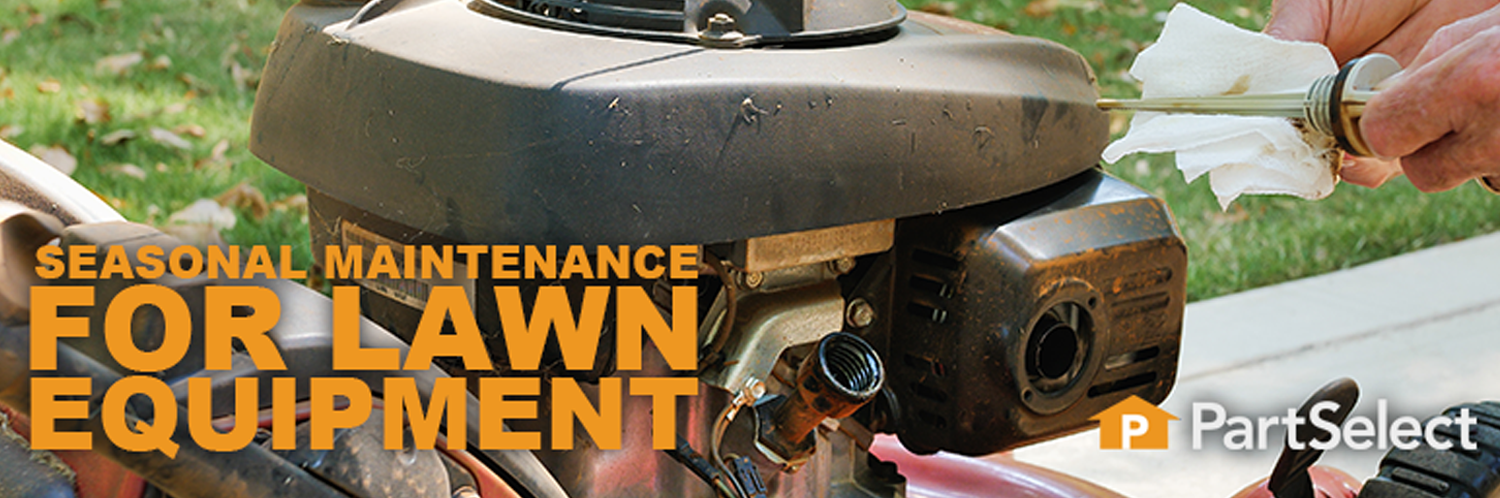
Seasonal Engine Maintenance for Lawn Equipment
It’s that time of year again, where the snow is (hopefully) melting, and you can start cleaning up your yard. Before you start tackling projects like trimming tree branches or pressure washing the walkways, you need to make sure your equipment is maintained. Whether you’re breaking out the lawn mower, chainsaw, or leaf blower, anything with a small two or four stroke engine needs a bit of TLC to run its best. In this article we’ll go over the various small engine parts to inspect, clean, and replace to ensure your lawn equipment starts and runs without any issues this spring.
Why Does a Small Engine Need Annual Maintenance?
In order to run efficiently and last for many years, the small engine in your lawn equipment requires routine, preventative maintenance. We suggest doing this annually, inspecting and replacing parts that are prone to wear like spark plugs and filters. The other parts and components of your equipment also require regular cleaning, inspecting, and replacement as necessary to keep the entire machine running smoothly. Using OEM replacement parts and maintenance kits ensure that they are compatible with your exact model of lawn equipment, and that the fit is guaranteed.
Benefits of Routine Equipment Maintenance
- Taking care of your equipment helps to prevent issues that could lead to complicated or expensive repairs if left ignored.
- Maintaining your lawn equipment is something you can easily learn to do yourself, saving you time and money compared to taking it into a shop.
- Performing both annual and routine maintenance helps to prevent downtime, ensuring that your lawn equipment will start and run smoothly when you need it.
- Properly maintained machines will reduce the chance of safety issues, preventing any accidents from happening.
- When your equipment runs properly, your lawn will look its best. Dull mower blades or malfunctioning line trimmers won't be able to cut properly, and will cause damage to your grass.
Change the Oil and Gas
Using fresh fuel and clean oil is essential for keeping your small engine operating. Gas will start to degrade in as little as 30 days, which will lead to internal components getting clogged and your equipment may not start. Old and contaminated engine old won't work as well to lubricate, cool, and clean your engine, which will give you poor performance. If you didn't change the oil and gas before storage in the fall, let's get those taken care of now.
Oil and Gas for Two-Stroke Engines
For your lawn equipment with a two-stroke engine, such as chainsaws, leaf blowers, or string trimmers, you will use an oil and fuel mix. These can be purchased pre-mixed (at a premium price) or you can make the mixture yourself. If you aren’t using a two-stroke machine often, the pre-mixed options already have fuel stabilizer in the formula which will prevent the fuel from breaking down and parts from getting gummed up. If you have a few different pieces of equipment to run, and use them often, mixing your own fuel and oil may be the better option. Check your owner's manual to determine if your equipment uses a 50:1 or a 40:1 ration of fuel to oil, and the type of oil to use. Many manufacturers offer their own brand of 2-stroke engine oil, but you can also find store-brand oils at most hardware stores.
Oil and Gas for Four-Stroke Engines
Lawn equipment with four-stroke engines, such as your lawn mower, don't use a pre-mixed solution and instead have separate caps for the oil and gas. It's important to change the engine oil at least once per year, and again after 50 hours of run time if you frequently use the equipment. For use from spring through to fall, you'll want to use an SAE-30 engine oil as this oil works best in temperatures above 40°F/4°C. You can check both the quality and the quantity of oil by checking the dip stick under the cap. If the oil on the dipstick comes out black or sludgy, you will need to change the oil. If the level of oil on the dipstick is near or below the lower dot, but the color is still light, you will want to top up the oil until the level is between the two dots.
Fresh fuel is essential for your equipment to run its best. If you stored your mower with stabilizer-treated fuel, we suggest draining this from the tank and adding new gas. If you completely drained the tank before storage last fall, you'll be good to add fresh gas. If you don't use your equipment often, adding fuel stabilizer now will help ensure the gas doesn't degrade inside your machine before you use it next. Your lawn equipment takes regular, 87 octane fuel that you can get from a gas station, but if you can get ethanol free gas, it will be better for the engine.
Inspect the Spark Plug
The spark plug is essential for ensuring combustion, and inspecting and replacing one is a simple task to complete. Using a spark plug wrench or a socket, remove the spark plug from your machine to check its condition. When inspecting the spark plug, check that the ceramic body isn't cracked, and for carbon soot buildup. The carbon can be cleaned off, but if there is too much buildup, replace the spark plug. We recommend changing the spark plug annually, and again after about 50 hours of use.
How to Remove and Replace a Spark Plug for a Small Engine
- First, locate where the spark plug is located on your lawn equipment. This will vary by model, so refer to your owner’s manual if needed. It will typically be located near the engine, and there will be a thick rubber wire and boot covering it. For equipment like a chainsaw, you may need to remove the engine cover first.
- Disconnect the boot by pulling it off of the spark plug.
- Using a spark plug wrench or socket, cover the spark plug and turn counterclockwise to loosen it.
- You should now be able to remove the spark plug and inspect it for signs of damage.
- When replacing the spark plug, thread it in place by hand first and then tighten it with the wrench to secure it in place.
- Reconnect the boot over the spark plug. You should feel it click into place.
Replace the Air Filter
Lawn equipment will have one of two different types of air filter, made of either paper or foam. This is another part that we suggest replacing annually to ensure that dust and debris doesn't make its way into your engine. Inspect your filter throughout the season and clean them if you're able.
- For paper filters, you can generally tap off any dirt, but if they're quite clogged, you'll want to replace them.
- Foam filters can be washed in warm soapy water, allowed to fully dry, and then ensure it's evenly coated in a bit of engine oil before reinstalling. If the foam is starting to disintegrate, replace the filter.
Inspect the Fuel Lines, Fuel Filter, and Primer Bulb
Check over the fuel lines to make sure there aren’t any cracks and that they’re properly connected to prevent leaks. The fuel filter is typically found within the fuel line, or inside the gas tank. These filters help prevent dirt or debris from making it to the carburetor and the engine. If the filter has become clogged, you’ll want to replace it to ensure that your lawn equipment runs efficiently. If your lawn equipment has a primer bulb, visually inspect it for any signs of cracking or brittle rubber. When you push the primer bulb, it should feel flexible and reform its shape. If the bulb won’t depress, stays flat, or doesn’t fill with fuel, it is likely damaged and should be replaced.
Inspect the Carburetor
The carburetor is responsible for maintaining the proper mixture of air and fuel to keep your small engine running efficiently. If both the air filter and fuel filter were dirty and clogged up, it’s likely that some debris has made its way to the carburetor as well. If this is the case, you’ll want to use a carburetor cleaning spray to take care of this issue. Depending on your model of lawn equipment, using a carb cleaning spray won’t require you to remove the carburetor from the machine. However, to thoroughly clean the carburetor, including the small internal jets that are prone to clogging, you will want to remove the carb from your equipment, disassemble it, and use an ultrasonic cleaner to get the job done. Ensuring that you keep up with routine maintenance like changing the oil, spark plug, air filter, and using fresh gas will all help to prevent any issues with the carburetor. If your inspection reveals any damage, you may need to replace the carburetor.
Inspect the Recoil Starter
Most of your lawn equipment with a small engine will have a recoil starter to get the machine running. With the spark plug boot disconnected (so you can’t accidentally start the engine) pull out the rope and check that it’s not stuck or fraying in spots or broken off completely. Release the cord back into the machine to ensure that the recoil is also functioning, and that the rope isn’t getting stuck or not retracting properly. Many recoil starters are sold as a complete assembly, but you can buy the individual parts like the rope or spring separately for some models. You can learn how to replace a recoil starter with our article, and find the exact part for your lawn equipment by searching with your model number.
Additional Maintenance Steps for Lawn Equipment
While taking care of the engine is essential to ensuring your machine starts and runs, there are other maintenance tasks that should be done in general, and ones that are model specific. We'll go over a general checklist below, and you can find more detailed step-by-step guides for model specific maintenance here on our blog.
- No matter what type of equipment you own, you should ensure that it is clean from debris like grass clippings, wood splinters, or dirt.
- Check over any bolts and screws to ensure they're tightly in place.
- Lubricate any moving parts to ensure they don't rust or seize up.
- For lawn mowers, sharpen the blades, inspect the various control cables and brakes, check the belt, and grease the wheel axles.
- For chainsaws, inspect the bar and chain, ensure there's bar oil, and check the brakes.
- For line trimmers, ensure that there is sufficient line and that it's wound correctly.
By taking care of these small engine components at the start of spring, you can help ensure that your lawn equipment will continue working its best all season long. As a general guideline, we recommend replacing parts like the spark plug and air filter, and changing the oil after 50 hours of run time. Be sure to always use fresh fuel in your equipment, or adding fuel stabilizer to help prevent it from degrading between uses. By taking the DIY approach to maintenance, you can save yourself time and money, along with extending the life of your lawn equipment.


Do you have broken recoil starter on a small engine like a lawn mower, snow...

Answering your most asked questions on oil and gas for your outdoor power e...
Learn the most common reasons for a lawnmower not starting, and how to fix ...