














Get in touch, we're here to help!
1-866-319-8402
Monday to Saturday
8am - 8pm EST
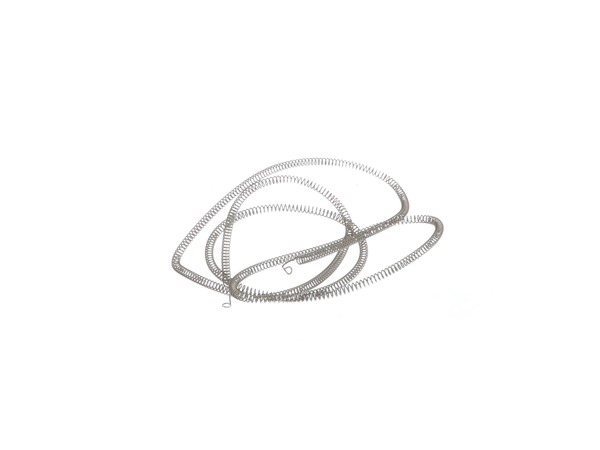
Dryer Heater Element 240v WPY313538
Easy
1- 2 hours
Jump to:
Dryer Heater Element 240v Specifications
How Buying OEM Parts Can Save You Time and Money
OEM stands for Original Equipment Manufacturer. Simply put, this means that the company who made your appliance is also supplying the replacement part for it.
- OEM from PartSelect
- Genuine brand name
- Guaranteed to fit
- Superior quality and durability
- 1 year warranty
- Generic
- Unknown manufacturer
- No fit guarantee
- Inconsistent quality and lifespan
- Limited warranty and support
Replacing your Maytag Dryer Dryer Heater Element 240v
- Not Heating
- Dryer
-
5 Stars 6
-
4 Stars 0
-
3 Stars 0
-
2 Stars 0
-
1 Star 0
- < Prev
- 1
- Next >
- < Prev
- 1
- Next >
- < Prev
- 1
- 2
- Next >
... Read more >shroud, and finally managed to get at the heater element terminals.
The heater element itself was open-circuit - what I had considered the least-likely point of failure. I went on PartSelect, found the heater assembly & element pages, and watched the video. Finally
pulled the front off the dryer, getting full access - how I should have started. Ordered the heating element (spring-coil of Nichrome wire)
rather than the entire heater assembly for two reasons: I could see that getting the thin sheet metal, two-part housing back into the distant punched-hole in the back plate would be the hard part, made very hard by any distortion of the cylinder, and anyway, lower cost.
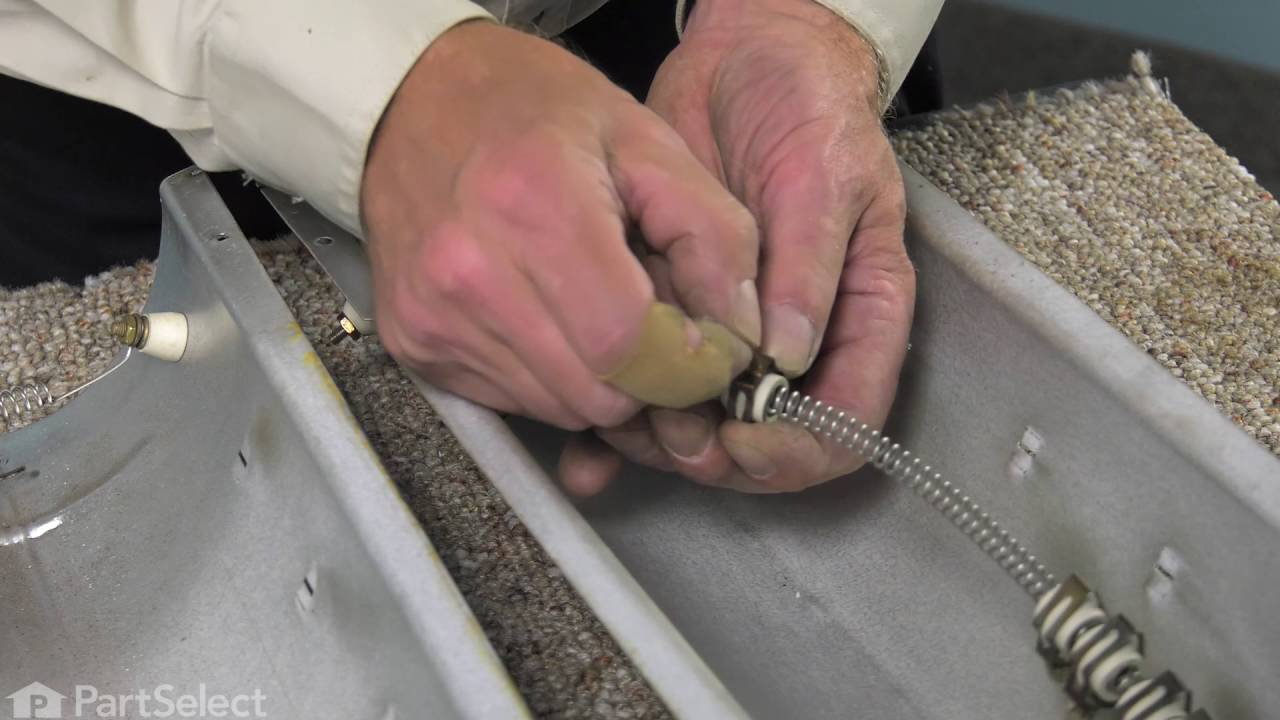
I used a long extension bar on a socket to reach the single self-tapping screw holding a tab extending from the far end of the housing, and a nut driver to remove the self-tapping screw holding the front. I disconnected the wire to the thermostat, the wire directly to the heating element, and pulled out the heater assembly. Removed the screws holding the two halves of the housing together, opened it up, and photographed it with my cellphone. Decided to use the technique in the video which meant removing all the ceramic stand-off's supporting the heater wire. This required using pliers to make a slight twist of the part of each stand-off that sticks through to the outside of the housing. Also had to flatten the spring-tab that is intended to lock the stand-off in place. Used a very small flat screwdriver the tabs back out before reinstalling the stand-off's. Slid the loose stand-off's on the new heating element and started at one of the ceramic power terminals, looping the element and inserting the stand-off's as I went, stopping short of the end and starting the other side from the ceramic power terminal on that end. As expected, I had to do a lot of adjusting of the loops to get enough slack to insert the stand-off's at the far end and get the housing closed and screwed together without distorting it. Finally fit the heater assembly housing back in that distant punched hole, the hardest step, as expected. Slip the two power wires back on the terminals, test the two previously-inaccessible thermostats for continuity, the resistance of the heating element for something plausible, and reinstall the door switch wire to the slip-on terminals.
Reinstall the front of the dryer by hanging it back up at the top,
swinging it down, and replacing the two screws angled-up from the bottom corners of the front. Put something wet in the drum, plug it in, and "smoke test" the dryer. Worked great for me - but do watch the PartSelect videos.
-
Margie T from PHILLIPSBURG, NJ
-
Difficulty Level:Really Easy
-
Total Repair Time:1- 2 hours
-
Tools:Nutdriver, Pliers, Screw drivers, Socket set
First, I verified volt ... Read more age (240V) at the outlet, then tested each of the thermostats for continuity using my multimeter. They were fine, but when I tested the heating coil it showed open (no continuity). When I removed the coil, I found it was broken about 1/2 way back. So that was all verification I needed.
I made the repair following the video on this site, and they do a great job of walking you through everything. The trickiest part was just taking the slack out of the heating element enough to put the shroud back together. It was cumbersome, but doable. Just gotta work the coil through each insulator to keep it from hanging up as you go. And keep tension on it, without pulling so hard that you stretch the wire. Definitely a good DIY job with only basic tools required.
-
Christopher from GLENWOOD SPGS, CO
-
Difficulty Level:Easy
-
Total Repair Time:30 - 60 mins
-
Tools:Nutdriver, Pliers, Screw drivers, Wrench (Adjustable)
Great Job On Your Side With The Video, Thanks Again!
-
Richard from JAX BCH, FL
-
Difficulty Level:Really Easy
-
Total Repair Time:30 - 60 mins
-
Tools:Screw drivers, Socket set, Wrench set
-
Steven from Sanford, NC
-
Difficulty Level:Easy
-
Total Repair Time:30 - 60 mins
-
Tools:Screw drivers, Socket set
! When the front is off it is a good time to use a vacuum cleaner to remove the lint that accumulates everywhere, especially in the air output !
-
Nikiforos from Skillman, NJ
-
Difficulty Level:A Bit Difficult
-
Total Repair Time:1- 2 hours
-
Tools:Nutdriver, Pliers, Screw drivers, Socket set, Wrench set
Shut off the power and unplug the machine.
Open the 'box'. Two screws in the front near the floor and hinge open.
Make a diagram of ever screw and piece you remove.
Diagnose the problem.
Order the necessary parts from ....
Replace the part. (The el ... Read more ement replace the second time in 30 years.)
Give the box a cleaning inside and out.
Put it back together.
Make sure all the parts you took out go back in.
Plug it in and turn on the power.
Test it.
Using a magnet to hold all the screws was helpful.
Having all the right tools is helpful. The requirements were pretty basic.
A good mechanical aptitude is essential or very helpful.
It is very important the exhaust port is patent. A leaf blower would be helpful in testing. I reversed the hose on our vacumn cleaner and packed foam around the tubbing to test it. (The local dealer warn me about using too much of the clothes softner.)
Karl Spees on behalf of my wife Soonja
-
Soonja from Port Angelas, WA
-
Difficulty Level:A Bit Difficult
-
Total Repair Time:More than 2 hours
-
Tools:Nutdriver, Pliers, Screw drivers, Wrench set
-
Donald from Woodlawn, TN
-
Difficulty Level:A Bit Difficult
-
Total Repair Time:1- 2 hours
-
Tools:Nutdriver, Screw drivers
-
John from College Place, WA
-
Difficulty Level:A Bit Difficult
-
Total Repair Time:30 - 60 mins
-
Tools:Nutdriver, Pliers, Screw drivers
2: Opened two halfs of the cowling by removing 4 screws on the flange.
3: Removed 2 nuts holding element ends to the cowling.
4: Removed bad element making note of how the element was threaded through porcelin element bracket/holders.
5: Installed new ... Read more element.
6: Reversed steps 1-3
-
Jeff from Hooksett, NH
-
Difficulty Level:Easy
-
Total Repair Time:1- 2 hours
-
Tools:Screw drivers, Socket set, Wrench set
-
Dustin from Washington, MO
-
Difficulty Level:Really Easy
-
Total Repair Time:30 - 60 mins
-
Tools:Nutdriver, Screw drivers, Socket set
- < Prev
- 1
- 2
- Next >
Ask our experts a question about this part and we'll get back to you as soon as possible!
- < Prev
- 1
- Next >
- < Prev
- 1
- Next >
Manufacturer Part Number: WPY313538
Get in touch, we're here to help!
1-866-319-8402
Monday to Saturday
8am - 8pm EST
Item is in stock and is estimated to be delivered in 2-3 business days via Standard Shipping.
Item is not in stock and usually ships 3-5 business days from the time you place your order.
Item is not in stock and usually ships 10-15 business days from the time you place your order.
This item is no longer being made by the manufacturer, and cannot be added to your shopping cart.