















Appliance Parts
- Accessories
- Dishwasher
- Dryer
- Stove / Oven
- Microwave
- Refrigerator
- Washer
- See more... See less...
Lawn Equipment Parts
- Lawn Mower
- Chainsaw
- Blower
- Generator
- Air Compressor
- Lawn Tractor
- Pressure Washer
- See more... See less...
Shop With Confidence









Instant Repairman
Enter your model number and our Instant Repairman will help diagnose and fix your appliance
How to test a microwave oven's diode:
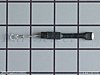 | Use our step-by-step microwave repair guide to learn how to test your diode. Once you have diagnosed the problem we have the OEM replacement diode that fits your appliance. NOTE: Before you test your diode, make sure your microwave is unplugged, and that you discharge the microwave's capacitor. Whether it is shorted or open, a defective diode will most likely show some sign of defect. Defective diodes will usually emit an electrical burning smell, signifying its defectiveness. Also, it may have split in two, or it may exhibit a burned crack, or possibly even a blistered spot. A shorted diode is indicated by a loud humming noise from the high voltage transformer, and no heat produced when a cook cycle is initiated. Whereas little or no heat produced in your microwave, with an absence of a humming noise is indicative of an open diode. In either case, the diode has to be replaced. With your microwave unplugged, and your capacitor discharged, use extreme caution to remove the lead that leads to the capacitor. You can leave the ground connection attached. The side of the diode that goes to the ground is usually marked with a dot, stripe, or arrow. Set your ohmmeter to R x 10,000 or higher. Touch the positive meter probe to the anode and the negative meter probe to the cathode to measure the resistance across the diode terminals. Remember that the cathode is on the side that goes to the ground, which is often marked by a dot, stripe, or an arrow. A normal diode, that is a non-defective diode, will read anywhere from 50,000 to 200,000 ohms. Differences in microwave make and model account for this large range in resistance readings. Reverse the meter probes and measure resistance while touching the positive probe to the cathode and the negative probe to the anode. Reversing the probes like this should result in a reading of infinity. Unless a bleeder resistor is present. The presence of a bleeder resistor would produce a reading of the value of the resistor. For more information about microwave diodes:
|
CAUTION: Your microwave oven is capable of giving you a serious electrical shock, even when it is unplugged. We strongly suggest you seek the assistance of an appliance repair technician when conducting any microwave oven repair.